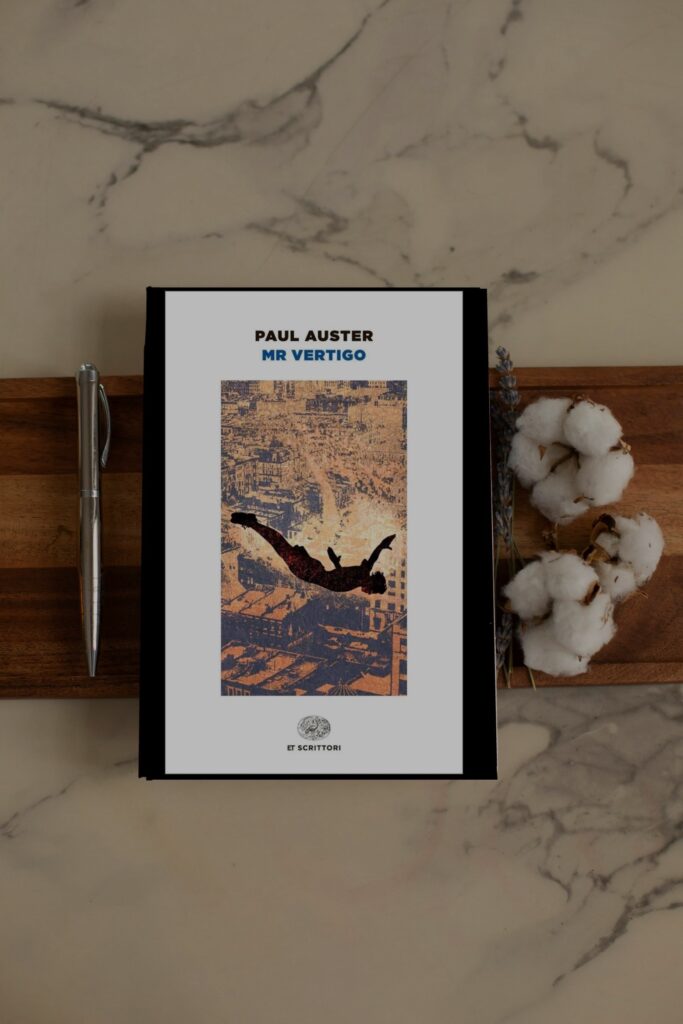
“An orphan’s journey to levitation and fame amidst the harsh realities of Prohibition-era America in Paul Auster’s ‘Mr. Vertigo.’”
Overview
“Mr. Vertigo,” written by Paul Auster in 1994, blends magical realism with a classic American coming-of-age tale. It follows Walt Rawley, a ten-year-old orphan who rises from the streets of St. Louis to fame as a levitating wonder. Under the enigmatic Master Yehudi’s strict tutelage, Walt learns to defy gravity. Set against Prohibition-era America and the rise of Nazism, the novel explores transformation, ambition, identity, and the way history shapes individual lives.
Plot Summary
Walt’s story opens in the late 1920s as he scavenges for pennies in a tough St. Louis neighborhood. Then, he meets Master Yehudi, a mysterious teacher who promises to make him levitate. Skeptical at first, Walt agrees to travel with Yehudi to an isolated Kansas farm.
On that farm, Walt endures rigorous—and often brutal—training. Moreover, he bonds with Mother Sioux, a Native American healer; Aesop, an African American boy scarred by racism; and Mrs. Witherspoon, who offers maternal care and wisdom. As Walt masters levitation, he and Yehudi hit the road, dazzling audiences across America.
However, fame brings challenges. Walt wrestles with his own identity and the cost of success. Then, the narrative darkens as he confronts betrayal, loss, and the looming evil of rising Nazism. These historical forces amplify the tension between Walt’s personal dreams and the march of global events.
Characters
- Walt Rawley: Our protagonist, whose transformation from street urchin to star performer mirrors his inner journey of self-discovery.
- Master Yehudi: Part guru, part father figure. His wisdom comes at a steep price, revealing mentorship’s moral ambiguities.
- Mother Sioux: A nurturing, mystical presence who grounds Walt in spiritual healing and connection to nature.
- Aesop: An African American boy whose tragic past highlights racial injustice and the search for belonging.
- Mrs. Witherspoon: A steady, maternal force who provides stability amid Walt’s turbulent training.
Themes
- Transformation and Self-Discovery: Walt’s levitation symbolizes the human urge to transcend limits and find one’s true self.
- Ambition and the Cost of Success: The novel shows how dreams can bring both triumph and pain.
- Identity and Belonging: Through Walt and his friends, Auster probes questions of race, background, and the meaning of family.
- Historical Influence: Prohibition and the rise of Nazism remind us how societal upheavals shape personal destinies.
- Good vs. Evil: Encounters with the Ku Klux Klan and Nazi sympathizers underscore the moral choices characters must face.
Symbolism
- Levitation: Represents transcendence and the pursuit of extraordinary goals.
- Master Yehudi: Embodies the archetypal wise man, illustrating that growth often demands hardship.
- The Farm: Symbolizes isolation and inner transformation away from worldly distractions.
- Fame and Fortune: Highlights success’s double edge—wealth and admiration, yet exposure to greed and corruption.
- Mother Sioux & Aesop: Reflect America’s diverse influences, from spiritual healing to marginalized voices.
- Era of Prohibition & Nazism: Stands for societal instability and the tension between personal dreams and historical forces.
Style and Narrative
Auster’s prose captures Walt’s rough, youthful voice and evolving wisdom. He deftly mixes magical realism with historical detail, creating vivid scenes that entertain and provoke thought. Furthermore, his reflective tone invites readers to ponder gravity’s literal and metaphorical meanings.
Conclusion
“Mr. Vertigo” offers a rich tapestry of wonder and history. Walt Rawley’s rise from orphan to levitator mirrors the broader American quest for identity and purpose. Above all, Paul Auster delivers a tale of resilience, transformation, and the human spirit’s capacity to soar—long after the final page is turned.