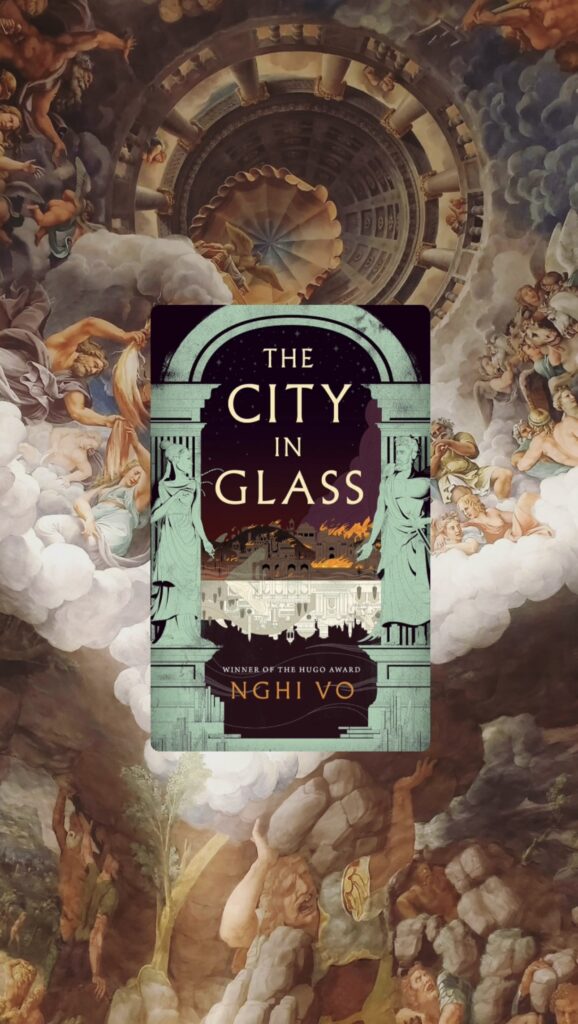
The City in Glass by Nghi Vo combines lush world-building with poignant themes of loss, grief, and renewal. The story centers around Vitrine, a demon who has painstakingly built the city of Azril, only to watch it be shattered by angels. Alongside an angel bound to her by a curse, Vitrine embarks on a journey to rebuild both the city and her sense of self. While the premise is captivating and the writing beautifully atmospheric, the novel ultimately left me feeling slightly disconnected, earning a balanced 3-star rating.
World-Building: A City That Breathes
Without question, the strongest aspect of this book is its vivid world-building. Azril, with its shimmering glass towers and bustling streets, is described with such rich detail that it practically becomes a character itself. Vo’s prose brings the city to life, creating an immersive experience. From Azril’s breathtaking grandeur to the heartbreaking imagery of its ruin, the city anchors the emotional landscape of the novel.
This captivating setting is what compelled me to keep reading, even when other elements didn’t resonate as strongly. Vo’s attention to detail is commendable, making the city’s destruction feel deeply impactful.
Character Development & Pacing: A Slow Journey
Despite the compelling setting, the novel falters somewhat in character development and pacing. Vitrine is an intriguing protagonist, strong yet vulnerable, with immense potential. However, her emotional depth never fully comes into focus. Her grief and determination are evident, yet her internal world remains somewhat distant, making it difficult to deeply connect with her journey.
I longed for more insight into Vitrine’s inner struggles, hoping for a deeper exploration of her humanity beneath her demonic exterior. While glimpses of vulnerability appear, they never fully bloom, leaving me wanting more.
Vitrine and the Angel: An Uneven Dynamic
The evolving relationship between Vitrine and the angel bound to her starts with intriguing tension and conflict. However, the development of their bond felt prolonged and occasionally flat. By the time their relationship reached genuine emotional depth, the slow pacing had diminished its impact.
While moments of meaningful connection exist, the emotional payoff wasn’t quite as satisfying as anticipated, leaving their relationship feeling underdeveloped.
At its core, The City in Glass thoughtfully engages with themes of loss, grief, and renewal. Vitrine’s journey of rebuilding, both physical and emotional, is moving in concept, but the exploration remains somewhat surface-level. The emotional distance throughout the narrative made it difficult for me to fully engage with these themes, despite their inherent richness.
I wished for a more nuanced and profound examination of the process of healing, both for Vitrine and the city itself. Deeper emotional exploration could have greatly enhanced the novel’s impact.
Final Thoughts: A Beautifully Crafted, Yet Distant Read
Overall, The City in Glass offers remarkable world-building and evocative prose but struggles with character depth and pacing, which hindered my emotional engagement. While there is much to appreciate, especially for fans of slower-paced, atmospheric fantasy, the novel fell slightly short of leaving a lasting impression.
Rating: ★★★☆☆ (3/5 stars)
Recommended for: Readers who appreciate rich, atmospheric storytelling and intricate world-building, and who don’t mind a slower narrative pace.